Why Your Building’s Exhaust Stack Is Costing You a Fortune
Every day, commercial and industrial buildings across North America do something remarkably wasteful: they burn natural gas to heat incoming ventilation air while simultaneously throwing away an enormous amount of usable heat through the exhaust stack.
Two systems. Running in parallel. Never talking to each other.
For building owners, operators, and mechanical engineers looking to reduce operating costs, meet decarbonization targets, and future-proof their assets, this is exactly the problem that active heat recovery ventilation was designed to solve.
What Is Active Heat Recovery?
Active heat recovery is a refrigeration-based technology that captures heat energy from a building’s exhaust air stream and transfers it directly to incoming fresh supply air — without any cross-contamination between the two air streams.
Unlike passive heat recovery systems such as energy wheels or glycol run-around loops, active heat recovery uses a refrigerant cycle (compressor, evaporator, and condenser) to actively upgrade and transfer heat. This means it doesn’t just partially warm the incoming air — it can bring outdoor air from as cold as -4°F (-20°C) all the way up to a 70°F (21°C) supply temperature, with no fossil fuel top-up required.
AIM’s FreshAIR Series is purpose-built around this principle. It’s a packaged heating, cooling, and heat recovery unit in a single cabinet — designed for commercial and industrial applications where ventilation loads are significant and energy costs are under scrutiny.
How the FreshAIR System Works
The operating principle follows the refrigeration cycle most engineers already know well, applied in reverse for heating:
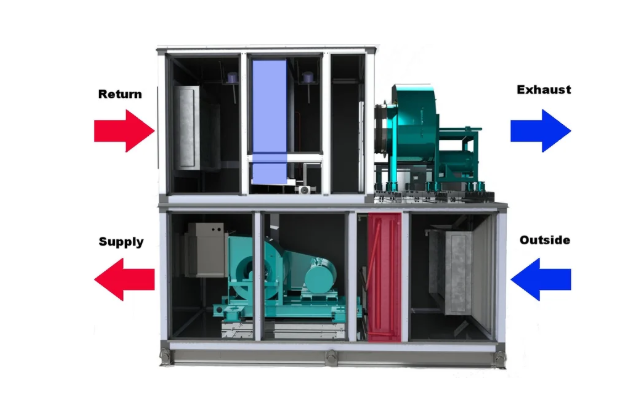
In heating mode, the evaporator sits in the exhaust air stream. As warm building exhaust air (typically 70°F) passes over the evaporator, refrigerant absorbs that heat energy. The compressor then upgrades the refrigerant temperature, and the condenser rejects that elevated heat into the incoming fresh air supply stream. Exhaust air exits at approximately 20°F — stripped of most of its usable energy. Supply air arrives at 70°F or higher — ready for occupant comfort, with zero gas consumption.
In cooling mode, the process reverses: the compressor extracts heat from the supply air via the evaporator, and rejects it to the exhaust air through the condenser — functioning as an efficient air-source cooling system.
Because the exhaust and supply streams are fully isolated by the refrigerant circuit, FreshAIR is safe for contaminated exhaust sources — including laboratories, industrial process exhaust, fume hoods, healthcare facilities, and toilet exhaust systems where energy wheels or direct plate exchangers cannot be used.
The Efficiency Numbers That Make You Stop and Listen
The performance case for active heat recovery comes down to one metric: Coefficient of Performance (COP).
A standard 80% efficient natural gas furnace has a COP of 0.8. Electric resistance heating achieves exactly 1.0. Even a modern air-source heat pump typically operates around a COP of 2.5 in cold climates.
The FreshAIR Series achieves:
- COP 4.5 at -4°F (-20°C) entering air conditions
- COP 7.8 at 32°F (0°C) entering air conditions
- Seasonal COP well above 5 across a Toronto/Ontario heating season
What this means in practical terms: for every kilowatt of electricity consumed by the compressor, the system delivers five to eight kilowatts of useful heat into the building. No combustion. No gas meter spinning. Just refrigeration physics doing the heavy lifting.
The Operating Cost Advantage
When modelled against Toronto weather data per 1,000 CFM of ventilation air, the annual operating cost comparison is striking:
| System | Annual Cost |
|---|---|
| Electric resistance heating | $82,043 |
| Natural gas heating | $47,900 |
| Air-source heat pump | $42,145 |
| Electric + heat recovery | $24,777 |
| Gas + heat recovery | $14,466 |
| FreshAIR Active Heat Recovery | $3,173 |
FreshAIR costs 93% less to operate than pure electric ventilation heating and roughly 93% less than a conventional air-source heat pump on an annual basis. For buildings handling 10,000 to 25,000 CFM of make-up air — a typical range for mid-to-large commercial buildings — that translates to tens of thousands of dollars in annual savings per unit.
Decarbonization Without Compromise
For building owners navigating ESG reporting, carbon taxes, LEED certification, or municipal emissions bylaws such as Toronto’s Mandatory Benchmarking and Disclosure requirements, the carbon math is equally compelling.
Annual CO₂ emissions per 1,000 CFM of ventilation air:
| System | Annual CO₂ (kg) |
|---|---|
| Natural gas heating | 144,585 kg |
| Gas + heat recovery | 43,665 kg |
| Air-source heat pump | 10,352 kg |
| FreshAIR Active Heat Recovery | 1,001 kg |
That’s a 99% reduction in carbon emissions compared to natural gas heating. For a mid-size commercial building running 15,000 CFM of outdoor air on gas heat, switching to FreshAIR could eliminate over 2 million kilograms of CO₂ annually — equivalent to removing hundreds of cars from the road.
As carbon pricing continues to rise across Canada and municipal decarbonization requirements tighten, the financial case for active heat recovery only strengthens with time.
Where FreshAIR Delivers the Most Value
Active heat recovery ventilation is most impactful in buildings where:
- Ventilation loads are high — office towers, manufacturing facilities, laboratories, long-term care homes, universities, and data centres
- Exhaust air is contaminated — preventing use of energy wheels or plate exchangers
- Heating seasons are long and cold — maximizing hours of COP advantage over gas
- Decarbonization targets are firm — where eliminating gas is a mandate, not just a preference
- Make-up air units (MUAUs) currently run on gas — the most direct one-for-one replacement application
Key Product Specifications
The FreshAIR Series is designed for industrial-grade reliability in demanding environments:
- Capacities from 2,000 to 25,000 CFM
- Dual independent refrigerant circuits for redundancy
- Hermetic VFD-driven scroll compressors
- Low-GWP refrigerant
- MERV-5 through MERV-20 pleated air filtration
- Tool-free removable access doors
- Remote monitoring via AIRbot
- Variable speed compressors and fan motors
- Available in 208–230V / 460V / 575V configurations
- Indoor or outdoor / rooftop mounting
- Optional explosion-proof construction
- Discharge temperatures up to 160°F available
The Bottom Line
Buildings that heat ventilation air with natural gas are paying a premium in both operating cost and carbon emissions that is no longer necessary. Active heat recovery ventilation technology — specifically the refrigeration-based approach at the core of the FreshAIR Series — delivers a fully fossil-fuel-free alternative that is measurably cheaper to run, dramatically lower in carbon output, and packaged for industrial reliability.
The exhaust air leaving your building right now contains recoverable energy. The question is whether you’re capturing it.
Advance Industrial Mechanical (AIM) manufactures specialized HVAC and decarbonization equipment for commercial and industrial applications across North America. To learn more about the FreshAIR Series or request a project-specific energy analysis, visit aimhvac.com or contact the HE Rieckelman Team.