SUMMARY:
● Air source heat pumps offer an efficient, all-electric solution for heating and cooling institutional buildings using the refrigeration cycle: evaporation, compression, condensation, and expansion.
● Modular heat pump and air handling systems improve reliability, provide flexible temperature control, and adapt to changing occupancy throughout the day.
● Modern cold-climate technology makes air source heat pumps a viable option even in Canadian winters.
● Schools and institutions benefit from lower energy costs, improved comfort, reduced maintenance, and lower greenhouse gas emissions.
● As institutions pursue sustainability and decarbonization goals, air source heat pumps are becoming a key component of modern HVAC system design.
From universities to elementary schools to recreation centres and municipal buildings, institutions across North America look for ways to reduce operating costs and lower their carbon emissions. Air source heat pumps are a highly effective way to do both.
Many people are familiar with residential heat pumps, but institutional systems operate on a much larger scale. Instead of heating or cooling a single home, these systems provide comfortable temperatures for hundreds or even thousands of occupants. These systems often need to serve specialized spaces with massively varying heating and cooling requirements room to room.
So how do these systems actually work? And why are they such a good fit for institutional buildings?
How does an air source heat pump work? Unlike a conventional furnace or boiler, an air source heat pump doesn’t create heat by burning fuel. Instead, it moves heat from one place to another using the refrigeration cycle. A traditional heating system uses a furnace or boiler to produce heat through burning fossil fuels. An air source heat pump doesn’t generate heat through burning but rather by moving existing heat from one place to another using the refrigeration cycle.
Even when the outdoor air feels cold, it will still contain thermal energy. A heat pump captures
this existing energy and transfers it indoors during the winter. In the summer, the process will
reverse, pumping the heat from in the building to the outdoors.
The refrigeration cycle, found in every heatpump, is a closed loop of four components:
● Evaporator
● Compressor
● Condenser
● Expansion valve
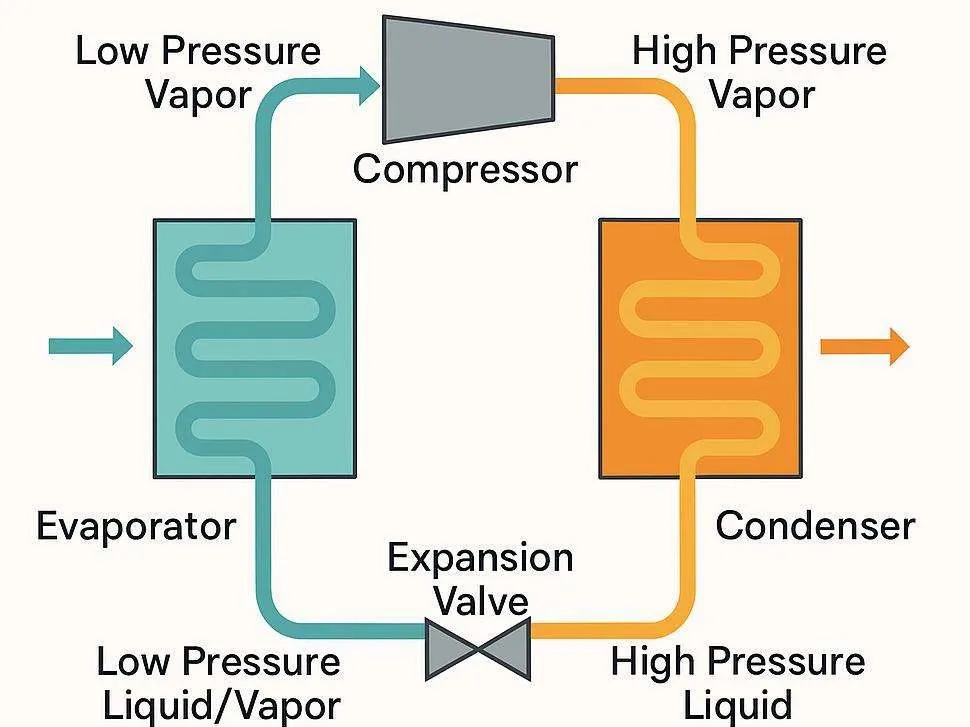
The refrigeration cycle begins with low pressure and temperature refrigerant entering the
evaporator. The refrigerant absorbs heat from the surrounding outdoor air causing it to evaporate
into a gas.
The compressor then takes this gas and raises both the pressure and temperature. The
compression adds enough heat to the gas so it can provide useful heating to the indoor air.
This hot gas travels through an indoor condenser, where heat transfer occurs, warming the
building’s air or water. As the refrigerate transfers heat, it condenses back into a liquid.
Finally, the refrigerant goes through the expansion valve, rapidly lessening the pressure and
temperature before it continues back to the evaporator to repeat the cycle.
The refrigeration cycle is highly efficient as the system transfers existing heat rather than
generating it through burning or electricity.
The air source heat pump has a dual functionality in the ability to reverse the refrigeration cycle.
By switching the direction of the flow of the gas, done by a reversing value, the same equipment
can provide heating or cooling depending on the season. This eliminates the need for separate
equipment for heating and cooling.
How do air source heat pumps work for institutional buildings?
Heating a standard single-family home can be very different from heating a hundred thousand
square foot school with classrooms, hallways, gymnasiums, cafeterias, offices and more.
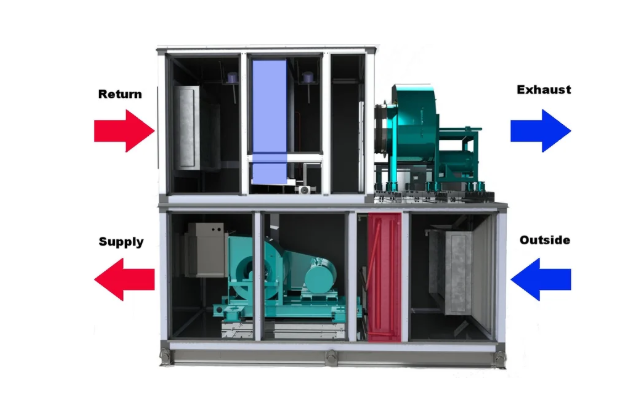
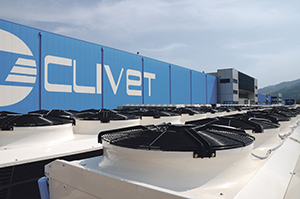
Due to their size, schools and institutions often do not rely on a single outdoor unit. Instead, large
buildings can use multiple air source heat pumps connected to an air handling system. This
allows different units to turn on and off as massive changes in heating and cooling needs occur
throughout the day.
For example, during the warmer months a school may need only a fraction of the cooling
overnight when the building is empty. As the temperature and occupancy increase throughout the
day a much larger amount of cooling will be needed. A modular system of multiple pumps
allows for only required equipment to run, increasing efficiency and reducing the individual wear
of each unit.
Additionally, within a school the different areas may require different comfortable ambient
temperatures. For example, a gymnasium will be more comfortable at a cooler temperature than
a classroom. A modular system allows different areas to maintain independent temperatures.
Moreover, a school or hospital cannot afford to have extended heating or cooling outages. A
modular system of air source heat pumps allows for redundancy. This means if one unit requires
maintenance, there will be multiple remaining units available to maintain comfortable
temperatures while repairs are being completed.
In extreme cold, many facilities incorporate gas or electric boilers to supplement heat during the
coldest periods of the year. However, cold-weather performance has improved significantly in
recent years. Modern cold-climate air source heat pumps can effectively operate when outdoor
temperatures are well below freezing.
A modular heat pump system paired with an air handler creates a flexible system capable of
efficiently heating and cooling large buildings with widely varying conditions. This is a great
system for schools and other institutions.
What are the benefits of air source heat pumps?
The biggest advantage of air source heat pumps is efficiency. They transfer heat rather than
generating it through combustion meaning they can deliver several units of heating energy for
every unit of electricity they use. This will lead to significant reduction in overall energy
consumption in comparison to other heating systems.
Heat pumps also have the benefit of reversibility offering heating and cooling with the same
equipment. This reduces both the cost of and need for maintenance when compared to
maintaining a system with boilers and chillers.
Additionally, a modular system of heat pumps can work with automation. The system will
continuously monitor indoor and outdoor temperatures and conditions, occupancy of various
areas of a building, and energy consumption. The controls use this data to operate specific heat
pumps at various capacities in live time. This is energy efficient and allows for more
customization of heating and cooling needs.
Heat pumps also offer greenhouse gas emission reduction. They consume electrical
energy rather than burning fossil fuels. As we shift more towards renewable energy sources, heat
pumps will continue to become more sustainable and have less emissions. Heat pumps are a
heating and cooling solution that aligns with decarbonization goals and supports the
environment.
Modular heat pump systems are more easily adapted in future building upgrades. With no
combustion process repairs will be cleaner and more straight forward. As institutions expand or
renovate, a modular heat pump system can be expanded much more easily than a centralized
boiler system.
Finally, heat pumps can create a more comfortable atmosphere for occupants. Traditional heating
methods rely on short bursts of intense heating while heat pumps can maintain consistent indoor
temperature . The noise levels generated can also be lessened when compared to older
equipment. The occupants will experience more stable temperatures throughout the day and
potentially also less noise.
Why are schools and institutions good applications?
Schools and other institutions create a strong case for using an air source heat pump system
because of how they are occupied.
These spaces are heavily used throughout the day and usually unoccupied during the evenings,
weekends, holidays, and summer breaks. A heat pump system paired with an automated control
system can easily adjust the system usage to account for these changes, reducing unnecessary
energy consumption when the spaces are empty.
Additionally, a zoning system more easily allows for varied temperatures in different zones. You
will find very different heating and cooling loads between classrooms, a library, a gymnasium, a
cafeteria, or an administrative office. Air source heat pump systems easily allow each unique
space to maintain appropriate temperatures.
Beyond energy savings, improved indoor comfort supports better learning environments. Stable
temperatures will result in less class time interruptions to grab a sweater from a locker. A quieter
operation level will allow students to have better focus.
Finally, many schools have ambitious sustainability projects and goals. Air source heat pumps
are highly energy efficient and will continue to reduce greenhouse gas emissions going into the
future.
Overall:
Air source heat pumps have grown beyond just residential applications. Institutions of today can
use automated systems of heat pumps and air handlers to provide reliable and energy efficient
heating and cooling for large spaces.
Air source heat pumps offer improved occupant comfort, support long-term decarbonization
goals, and simplify HVAC systems. Current cold-climate heat pumps can operate in temperatures
as low as -30°C (-22°F) and as this technology continues to improve, heat pump systems become
an increasingly important part of institutional HVAC design.
By: Mae Perri