Summary
- The ground stays at a stable 8–13°C year-round below the frost line, making it a far easier energy source/sink than outdoor air — warmer than winter air, cooler than summer air.
- A closed-loop borefield circulates fluid that exchanges heat with the earth, while a refrigeration cycle inside the heat pump (evaporator, compressor, condenser, expansion valve) moves that energy into the building’s water loops.
- Centralized plants distribute hot and chilled water to suites through risers feeding fan coils, radiant systems, or ventilation equipment — distinct from the “4-pipe vs. 6-pipe” question at the plant level.
- 4-pipe plants can only heat or cool the whole building at once; 6-pipe plants add a third independent loop, enabling simultaneous heating and cooling, smaller borefields, and year-round DHW heat recovery.
- Tandem Chillers (Markham, Ontario) achieves 6-pipe performance with three dedicated internal heat exchangers per loop — avoiding the fluid carryover and extra external heat exchanger that valve-based 6-pipe designs often require.
Ground-source heat pumps — also called geothermal heat pumps — are quickly becoming one of the most talked-about systems for new condos, apartments, and mixed-use developments in Ontario. They’re efficient, they’re electric, and they help projects hit increasingly strict carbon targets like the Toronto Green Standard. But for a lot of building owners, developers, and even mechanical contractors, the actual mechanics of how a centralized geothermal plant heats and cools dozens or hundreds of suites at once stays a bit of a black box.
This article breaks it down into three pieces: how the ground itself is used as an energy source, how the heat pump’s refrigeration cycle actually moves that energy, and how that energy gets distributed to individual suites. Then we’ll get into a decision that has a bigger impact on building performance than most people realize: choosing a 4-pipe versus a 6-pipe heat pump configuration for the central plant.
The Ground: A Free, Stable Energy Reservoir
Air temperatures in Ontario swing wildly — from -20°C in January to 35°C in July. The ground doesn’t. Once you get below the frost line, roughly 2–2.5 metres (6–8 feet) down, soil and rock settle into a relatively constant temperature year-round, generally somewhere in the 8–13°C range depending on depth and location.
That stability is the whole point. A geothermal system doesn’t generate heat — it moves it. In winter, the ground is warmer than the outdoor air, so it’s a much easier place to pull heat from than the atmosphere. In summer, the ground is cooler than the outdoor air, so it’s a much easier place to dump heat into. Either direction, the heat pump is working against a far smaller temperature difference than an air-source system would face, which is the main reason ground-source systems run more efficiently.
For a multi-residential building, this energy exchange happens through a closed-loop borefield — a field of vertical boreholes (sometimes 100–200+ metres deep, depending on load and available land) filled with U-tube piping that circulates a water or water-glycol solution. That fluid never touches groundwater directly; it simply absorbs heat from the surrounding earth in winter and rejects heat into it in summer. Over a full year, the ground effectively acts as seasonal thermal storage — charged with rejected heat over the cooling season, discharged of that heat over the heating season.
Inside the Heat Pump: The Refrigeration Cycle, Simplified
The borefield fluid never directly heats or cools the building — it transfers its energy to a refrigerant inside the heat pump, which is where the real work happens. The cycle has four basic steps:
- Evaporator: In heating mode, relatively cool refrigerant absorbs heat from the warmer ground loop fluid, causing it to boil into a low-pressure gas.
- Compressor: That gas gets compressed, which raises both its pressure and its temperature significantly — this is the only step in the cycle that consumes meaningful electricity.
- Condenser: The hot, high-pressure refrigerant gives up its heat to the building’s water loop, condensing back into a liquid in the process. This is the heat that ends up warming the suites.
- Expansion valve: The liquid refrigerant drops in pressure and temperature, and the cycle starts over.
A reversing valve allows the same hardware to run the cycle backward for cooling mode — pulling heat out of the building loop and rejecting it to the ground loop instead.
The reason this matters for efficiency: a compressor consuming one unit of electrical energy can move three, four, or sometimes five-plus units of heat energy, because most of that heat was already sitting in the ground for free. That ratio is the system’s Coefficient of Performance (COP), and it’s the core economic argument for geothermal — lower operating cost and a smaller carbon footprint than combustion-based heating, especially on Ontario’s relatively clean electrical grid.
Getting Heat (and Cooling) to the Suites
In a centralized configuration, the heat pump plant lives in one mechanical room — not in every unit — and produces hot and/or chilled water that’s distributed throughout the building via vertical risers. From there, a few common terminal technologies take over inside each suite:
- Fan coil units (FCUs): The most common approach in mid- and high-rise residential. Hot or chilled water circulates through a coil, and a fan blows suite air across it. These can be 2-pipe (heating or cooling only, one mode at a time) or 4-pipe at the suite level (independent heating and cooling coils, fed from separate risers).
- Radiant systems: In-floor or in-ceiling hydronic piping for a quieter, more even heating/cooling experience, often paired with a separate ventilation system for fresh air and any supplemental cooling load.
- Ventilation integration: Many buildings also run the hydronic loops through a dedicated outdoor air system (DOAS) or ERV to pre-heat or pre-cool incoming fresh air before it ever reaches the suite.
It’s worth flagging a naming overlap here: “4-pipe” at the suite/terminal unit level (heating coil + cooling coil) is a different conversation from “4-pipe vs. 6-pipe” at the central plant level — which is about how many independent water loops connect to the heat pump itself. That’s the more consequential decision, and it’s where we’ll spend the rest of this article.
4-Pipe vs. 6-Pipe Systems: Why the Plant Configuration Matters
A 4-pipe central heat pump plant has two water connections: one to the geothermal loop, one to the building’s hydronic loop. Internally, the unit has one evaporator and one condenser, and a reversing valve flips which one does which job. The result: the entire plant operates in either heating mode or cooling mode at any given moment, building-wide. That’s perfectly workable for buildings with fairly uniform, seasonal loads — but multi-residential buildings rarely fit that profile. A west-facing penthouse suite calling for cooling on a sunny October afternoon while a north-facing ground-floor suite is calling for heat is a completely normal scenario, and a 4-pipe plant can’t serve both needs at the same time.
A 6-pipe (also called multi-pipe) plant adds a third independent loop — typically a geothermal/source loop, a building chilled-water loop, and a building hot-water loop, each with its own dedicated set of supply and return piping (three loops × two pipes = six pipes). Internally, the unit can run heating and cooling simultaneously: pulling heat out of the chilled-water loop on one side while rejecting it into the hot-water loop on the other, using the ground loop only to absorb or supply whatever net difference remains between the two.
Why 6-Pipe Makes Sense for Multi-Residential Buildings
That simultaneous heating-and-cooling capability isn’t a nice-to-have in a multi-suite building — it’s usually the better design for several concrete reasons:
- True heat recovery between suites: Heat pulled from a suite that needs cooling can be redirected to heat a suite that needs warming, instead of being rejected to the borefield and then re-extracted somewhere else at a cost.
- Domestic hot water preheat, year-round: The hot-water loop can capture recovered heat to preheat DHW even in the middle of summer, when most of the building is in cooling mode — energy that a 4-pipe system would otherwise just dump into the ground.
- Smaller borefield requirements: Because the ground loop only has to handle the net imbalance between heating and cooling demand rather than the gross load of each, the borefield can often be sized smaller — a direct capital cost saving on what’s usually the most expensive part of the system.
- Lower overall operating cost: Less reliance on the ground loop to satisfy every BTU of heating or cooling means less compressor work overall, which shows up directly in utility bills.
- No building-wide mode lockout: Suites aren’t held hostage to whatever mode the rest of the building happens to be in that day.
A Closer Look: Tandem Chillers’ Approach to 6-Pipe Design
Not all 6-pipe-rated equipment achieves this the same way, and the difference matters more than it might seem on a spec sheet.
Some six-pipe systems on the market use a single pair of heat exchangers (one evaporator, one condenser) and rely on a network of motorized valves to redirect which external loop — ground, chilled water, or hot water — is connected to which heat exchanger at any given moment. Because the same physical heat exchanger surface alternates between different fluid loops over time, there’s a real risk of fluid carryover between circuits, particularly between a glycol-treated ground loop and a clean building loop. Many of these designs end up needing an additional external plate-and-frame heat exchanger downstream just to fully isolate the building water from the ground loop fluid — extra equipment, extra pumps, extra approach-temperature losses, and another component to maintain.
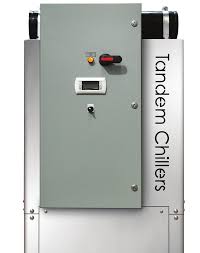
Tandem Chillers, a modular chiller and heat pump manufacturer based in Markham, Ontario, takes a different approach: each of the three loops — ground/source, building chilled water, and building hot water — runs through its own dedicated internal heat exchanger. The fluids are never routed through a shared heat exchanger surface and never cross paths inside the unit, so there’s no carryover to manage and no external isolation heat exchanger required. It’s a simpler, more robust execution of the same 6-pipe concept: full simultaneous heating and cooling, true loop isolation built into the unit itself rather than bolted on afterward, and — as a bonus for projects with Buy Ontario or local-content considerations — equipment designed and built in Canada.
For multi-residential projects, that translates into a smaller mechanical room footprint, fewer components for the building’s maintenance team to service, and one less point of failure in a system that’s expected to run reliably for decades.
The Bottom Line
Ground-source heat pumps work by using the earth’s stable temperature as an energy reservoir, a refrigeration cycle to move that energy efficiently, and a distribution network to deliver it to individual suites. For multi-residential buildings specifically, the choice between a 4-pipe and 6-pipe central plant configuration has an outsized impact on efficiency, borefield sizing, and tenant comfort — and how a manufacturer actually engineers that 6-pipe capability internally is worth a closer look during equipment selection.
If you’re evaluating geothermal options for an upcoming multi-residential project, our team can help walk through system sizing, loop configuration, and equipment selection for your specific site.